
Back pain that shoots into your leg. A stiff neck with tingling down your arm. When symptoms like these show up, many people hear the words “herniated disc” or “bulging disc” and immediately worry about the worst.
The good news is that many disc problems improve with conservative, non-surgical care. Chiropractic care is one option people in Athens often explore. Here is what discs do, what goes wrong, and how a chiropractor may be able to help.
What Are Spinal Discs?
Between each of the bones in your spine (vertebrae) sits a disc. Each disc has two parts:
- A tough outer ring that holds everything in place
- A softer, gel-like center that acts as a cushion
Together they absorb shock, allow your spine to bend and twist, and keep the vertebrae from rubbing against each other. Discs are in your neck, mid-back, and lower back, though problems are most common in the lower back and neck.
Bulging Disc vs. Herniated Disc: What’s the Difference?
The two terms are often used interchangeably, but they are not quite the same.
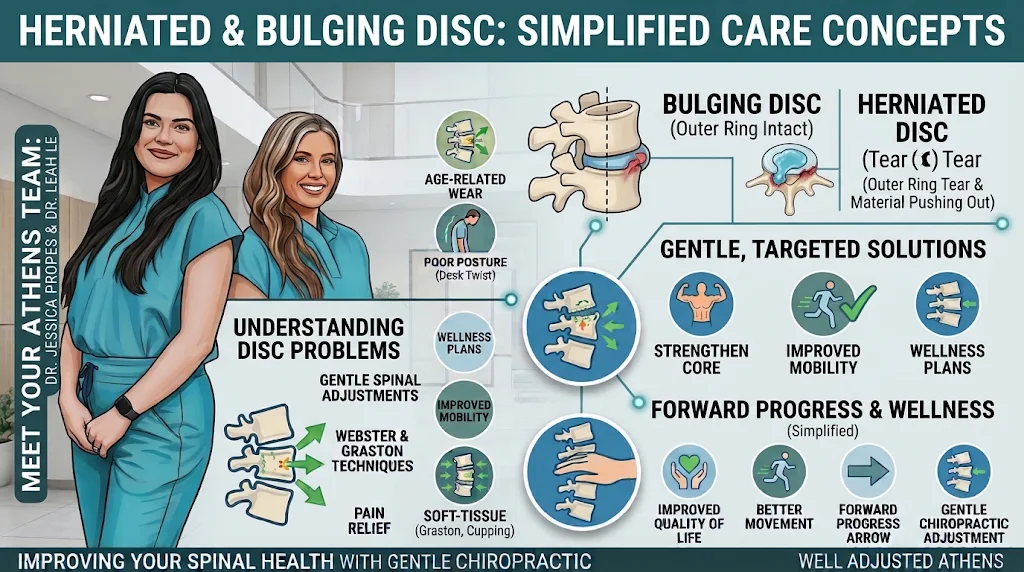
- Bulging disc: The disc extends outward beyond its normal boundary, but the outer ring is still intact. Think of a tire bulging in one spot.
- Herniated disc: The outer ring has a tear or crack, allowing some of the soft inner material to push out. This is sometimes called a “slipped” or “ruptured” disc, although the disc does not literally slip out of place.
Many people have bulging or even herniated discs without any pain at all. Symptoms appear when the disc irritates or presses on a nearby nerve, or when the area becomes inflamed.
Common Causes of Disc Problems
Discs naturally lose water and flexibility with age, which makes them more vulnerable. Other contributors include:
- Age-related wear and tear
- Poor posture over many years (see how poor posture causes neck and back pain)
- Heavy lifting or twisting with poor technique
- Repetitive strain from work or sports
- Prolonged sitting, which increases pressure on the lower spine
- Sudden injury, such as a fall or accident
- Excess body weight, which adds load to the spine
- Smoking, which may affect disc health over time
Symptoms of a Herniated or Bulging Disc
Symptoms depend on where the disc is and whether a nerve is affected.
Lower back:
- Pain in the lower back, buttock, or hip
- Pain, numbness, or tingling that travels down one leg
- Muscle weakness in the leg or foot
- Pain that worsens with sitting, bending, coughing, or sneezing
Neck:
- Neck pain or stiffness
- Pain between the shoulder blades
- Pain, numbness, or tingling that radiates into the shoulder, arm, or hand
- Weakness in the arm or hand
If leg pain is your main complaint, you may also be wondering about sciatica and whether a chiropractor can fix it. Disc problems are one of the possible causes of sciatica-type symptoms. A similar overlap exists with pinched nerves.
Can a Chiropractor Help a Herniated or Bulging Disc?
For many people, yes. Chiropractic care may help reduce pain and improve movement in cases of disc-related back and neck pain. Research suggests that spinal manipulation can be an option for some people with low back pain, including pain linked to disc problems, although results vary from person to person.
It’s important to be clear about what chiropractic care does and does not do. It does not “push a disc back in.” Instead, the goals are to:
- Reduce pain and irritation around the affected area
- Improve joint motion and spinal mobility
- Ease muscle tension and guarding
- Help you move more comfortably
- Support healing by guiding safe activity and posture
How Chiropractic Care May Help
A Thorough Exam First
Care starts with a detailed history and physical exam. Your chiropractor will look at your posture, range of motion, reflexes, strength, and sensation, and may recommend imaging such as an X-ray or MRI, or refer you to another provider, when appropriate.
Gentle, Targeted Techniques
If the disc is irritated or inflamed, forceful adjustments may not be the right choice. Chiropractors often use gentler approaches, which can include:
- Low-force or instrument-assisted adjustments
- Flexion-distraction technique, a gentle table-based method that uses slow, rhythmic movement to help take pressure off the spine
- Soft-tissue work, including options like Graston technique and cupping, to relax tight muscles around the area
Exercise and Lifestyle Guidance
Your care plan may include stretches, core-strengthening exercises, and guidance on posture, lifting, and daily habits. These help support your spine between visits and may lower the chance of flare-ups.
Chiropractic Care vs. Other Options
Chiropractic care is one of several conservative choices. Others include physical therapy, massage, medications prescribed by your doctor, and, in some cases, injections or surgery. If you are comparing your options, our guide to chiropractic vs. physical therapy vs. massage therapy can help.
If you’re looking for ways to manage pain without relying on medication, read how to manage chronic back pain without opioids.
When a Chiropractor May Not Be the Right First Step
Chiropractic care is not appropriate for every disc problem. Your chiropractor may refer you to a medical provider if you have:
- Significant or worsening muscle weakness
- Symptoms that are not improving, or are getting worse, with care
- Findings on your exam that suggest a more serious problem
- A history that calls for imaging or specialist evaluation
A good provider will be honest about what they can and cannot treat, and will coordinate your care when needed.
Red Flags: Seek Emergency Care Right Away
Rarely, a disc problem can compress nerves severely. Go to the emergency room or call 911 if you experience:
- Loss of bladder or bowel control
- Numbness in the groin, genitals, or inner thighs (sometimes called “saddle numbness”)
- Sudden or rapidly worsening weakness in a leg or arm
- Severe pain that is not relieved by rest, especially with fever or after a major injury
These can be signs of a serious condition that needs urgent medical attention. Do not wait for an appointment.
Tips to Protect Your Discs
Whether you’re recovering or trying to prevent problems, these habits help:
- Stay active. Gentle movement, such as walking, is usually better than prolonged bed rest.
- Sit smarter. Take breaks to stand and move every 30 minutes or so.
- Lift with your legs, keeping the load close to your body and avoiding twisting.
- Strengthen your core. Strong abdominal and back muscles help support your spine.
- Sleep well. Your position matters. See our guide to the best sleeping positions to avoid neck and back pain.
- Manage your weight and avoid smoking to support overall spine health.
Frequently Asked Questions
Can a herniated disc heal on its own?
Many herniated discs improve over weeks to months with conservative care, and symptoms often ease as the body reduces inflammation. Healing time varies from person to person.
Is chiropractic care safe for a herniated disc?
For many people it can be, especially when techniques are matched to the person’s condition. A thorough exam is important first, and your chiropractor should tell you if another type of care is needed.
How many visits will I need?
It depends on the severity of your symptoms, how long you’ve had them, and how you respond. Your chiropractor can outline a plan after your exam. Our article on how often you should see a chiropractor explains what influences visit frequency.
Will I need surgery?
Most people with disc problems do not need surgery. It is usually considered only when conservative care has not helped or when there are serious symptoms such as significant weakness or loss of bladder or bowel control.
What if I feel sore after treatment?
Mild soreness can be normal. Read our guide on what’s normal after a chiropractic adjustment.
Final Thoughts
A herniated or bulging disc can be painful and worrying, but you have options. For many people, gentle chiropractic care, along with exercise and lifestyle changes, can help reduce pain and get them moving more comfortably. The key is a careful exam and a plan that fits your situation.
At Well Adjusted Athens, our team takes the time to understand what’s causing your pain and builds a care plan around you. If you’re dealing with back, neck, arm, or leg pain, we’re here to help.
Ready to find relief? Book your appointment at Well Adjusted Athens today.
This content is for general education and is not a substitute for personal medical advice. If you have concerns about your symptoms, speak with a qualified healthcare provider.