
If you’re dealing with pain, stiffness, or an injury, you’ve probably wondered which type of provider is actually the right fit — a chiropractor, a physical therapist, or a massage therapist. All three can help with musculoskeletal issues, but they approach the body very differently, and picking the right one (or the right combination) can make a real difference in how quickly you feel better.
Here’s a clear breakdown to help you decide.
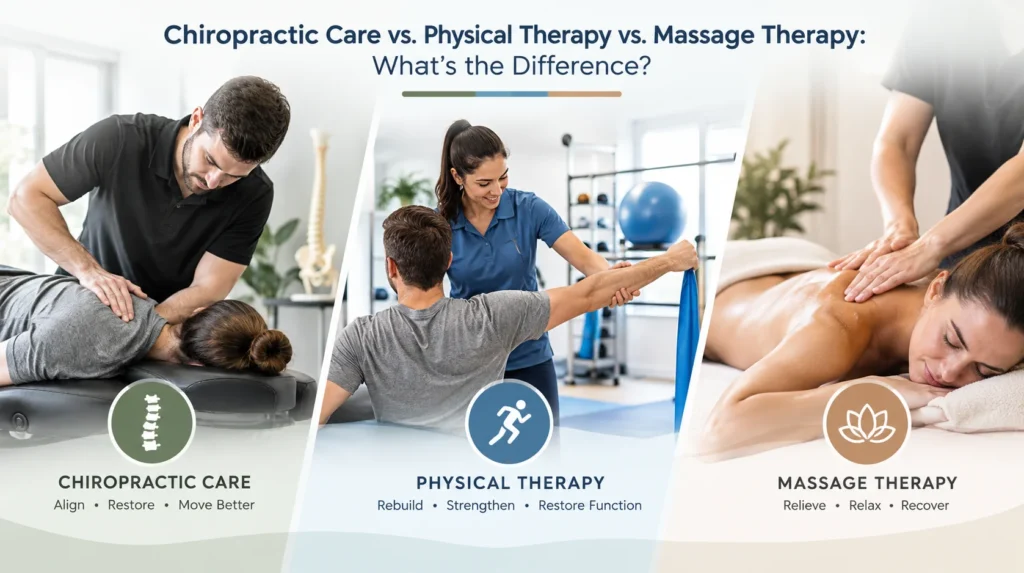
The Quick Answer
- Chiropractic care focuses on the alignment and mobility of your spine and joints, using hands-on adjustments to relieve nerve interference and restore function.
- Physical therapy focuses on rehabilitation through exercise, movement retraining, and strengthening, often after surgery, injury, or for long-term functional recovery.
- Massage therapy focuses on the soft tissue — muscles, fascia, and tendons — to relieve tension, improve circulation, and support relaxation and recovery.
They’re not competitors so much as different tools for different (and sometimes overlapping) jobs.
Chiropractic Care: Best For Joint and Nerve-Related Issues
Chiropractic care centers on the relationship between your spine, joints, and nervous system. Using precise, controlled adjustments, chiropractors work to correct misalignments and restricted joint movement that can cause pain, reduce mobility, or put pressure on nearby nerves.
Chiropractic care tends to be the right starting point for:
- Back and neck pain related to alignment or joint restriction
- Sciatica or nerve-related symptoms like tingling and numbness
- Headaches stemming from spinal or postural tension
- Joint pain in the shoulders, hips, knees, or other extremities
- General postural issues, including “tech neck”
Unlike physical therapy, chiropractic visits are typically shorter and more frequent in the early stages of care, with hands-on adjustments performed at each visit.
Physical Therapy: Best For Rehabilitation and Long-Term Strength
Physical therapy is centered on movement and function — helping your body rebuild strength, flexibility, and mobility over time, often through a structured exercise program.
Physical therapy tends to be the right fit for:
- Recovery after surgery
- Rehabilitation following a significant injury
- Building strength and stability after an area has been immobilized (like a cast or brace)
- Long-term functional training for conditions like chronic joint instability
- Sports performance and injury prevention programs
Physical therapy sessions are typically longer and more spaced out than chiropractic visits, with a strong emphasis on exercises you’ll also do at home between sessions.
Massage Therapy: Best For Muscle Tension and Relaxation
Massage therapy works directly on soft tissue — muscles, fascia, and connective tissue — to relieve tension, break up adhesions, and improve blood flow.
Massage therapy tends to be the right fit for:
- General muscle tension and tightness
- Stress-related physical tension
- Supporting recovery between chiropractic adjustments
- Improving circulation and relaxation
- Complementing athletic training or recovery routines
Unlike chiropractic care or physical therapy, massage therapy doesn’t directly address joint alignment or long-term functional rehabilitation — it’s most effective as a complement to those approaches, not a replacement for them.
Do You Need Just One, or a Combination?
For many patients, the most effective approach isn’t choosing just one of these — it’s combining them strategically:
- A chiropractor might address the underlying joint misalignment causing your back pain, while soft tissue work like cupping therapy or massage helps release the surrounding muscle tension contributing to it.
- Someone recovering from a sports injury might benefit from chiropractic adjustments to restore joint mobility, paired with therapeutic exercises to rebuild strength and prevent re-injury.
- A patient with chronic tension might use regular chiropractic care for structural alignment and massage therapy for ongoing muscular relief.
How to Decide Where to Start
A simple way to think about it:
- If your pain feels connected to a specific joint, your spine, or involves numbness/tingling — start with a chiropractic evaluation.
- If you’re recovering from surgery or a significant injury and need to rebuild strength and mobility — physical therapy is likely the right foundation.
- If your main issue is general muscle tightness, tension, or stress — massage therapy may offer the most direct relief.
If you’re not sure which applies to you, a chiropractic evaluation is often a good first step, since it can help identify whether your issue is primarily structural, muscular, or functional — and guide you toward the right combination of care from there.
A Team-Based Approach at Well Adjusted Athens
At Well Adjusted Athens, we combine chiropractic adjustments with complementary techniques like cupping therapy, Graston Technique, and therapeutic exercises — giving many patients a more complete approach without needing to coordinate between multiple separate providers.
Not sure which approach is right for you? Schedule a consultation with Well Adjusted Athens, and we’ll help you figure out the best path forward based on your specific symptoms and goals.
Book Appointment | Call us: 706-202-3847