
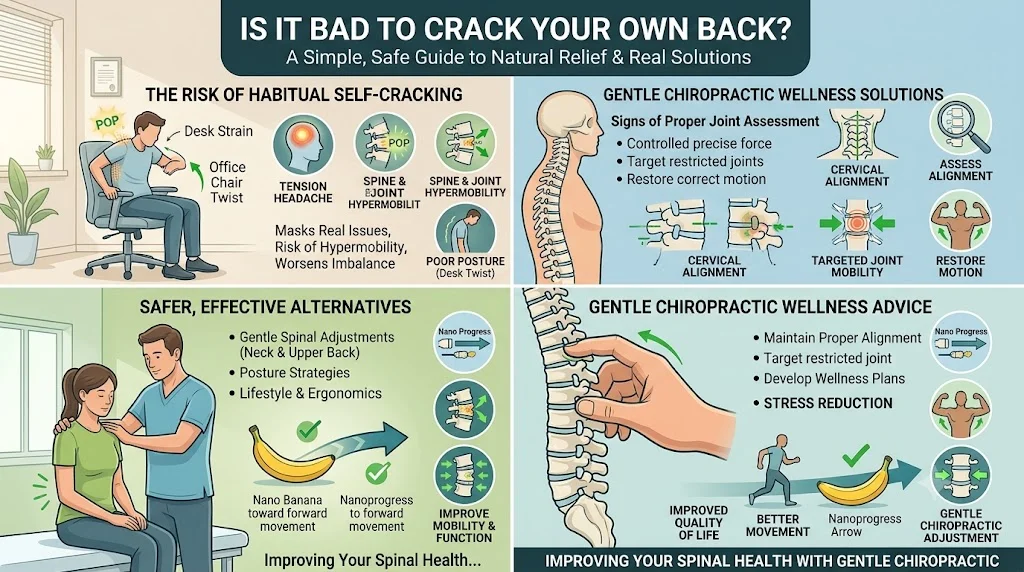
If you’ve ever twisted your torso in your office chair until you heard a satisfying pop, you’re not alone. Cracking your own back is one of the most common habits people don’t think twice about — it feels good, it seems harmless, and for many people it’s become a daily ritual.
But is it actually bad for you? As chiropractors, this is one of the questions we hear most often at our Athens clinic. Here’s the honest, evidence-based answer.
What’s Actually Happening When Your Back “Cracks”
That popping sound isn’t your bones grinding or shifting out of place — it’s a phenomenon called cavitation. Your spinal joints are surrounded by a lubricating fluid called synovial fluid, which contains dissolved gases (mostly carbon dioxide). When you stretch or twist a joint beyond its normal range, the pressure inside the joint capsule drops suddenly, and those gases form a bubble that collapses with an audible pop.
This is the same mechanism behind cracking your knuckles. It’s not inherently dangerous, and it doesn’t mean anything was “out of place” and is now “back in place” — that’s a common misconception.
So Why Does It Feel So Good?
Cracking your back often produces temporary relief, and there are a few real reasons why:
- Increased joint mobility. The stretch involved in self-cracking briefly increases range of motion in that joint.
- Endorphin release. Stretching and joint movement can trigger a mild release of feel-good chemicals.
- Reduced muscle tension. The movement can temporarily relax tight muscles surrounding the joint.
The relief is real — the problem is that it’s usually short-lived, and repeatedly chasing that feeling can create bigger issues over time.
The Risks of Habitually Cracking Your Own Back
Occasionally cracking your back isn’t likely to cause harm. But when it becomes a frequent habit — especially several times a day — it can contribute to a few problems:
1. Joint hypermobility Repeatedly forcing a joint past its normal range can gradually loosen the surrounding ligaments. Over time, this can make the joint less stable, which paradoxically makes it feel like it “needs” to crack even more often — a cycle that’s hard to break.
2. Masking the real problem Most people don’t crack their back because they’re bored — they do it because something feels tight, stiff, or misaligned. Self-cracking treats the symptom, not the cause. If you feel the urge to crack your back multiple times a day, that’s usually a sign of an underlying issue — like poor posture, muscle imbalance, or spinal misalignment — that isn’t actually being resolved.
3. Cracking the wrong joint When you twist yourself to get a crack, your body often takes the path of least resistance — meaning the already mobile joints move even more, while the stiff, restricted joints (the ones that actually need attention) don’t move at all. This can worsen the imbalance between overly mobile and overly stiff segments of your spine.
4. Risk of injury with aggressive movements Aggressive self-manipulation — especially of the neck — carries a small but real risk of muscle strain, nerve irritation, or joint injury, particularly if done forcefully or without understanding proper spinal mechanics.
Self-Cracking vs. a Professional Chiropractic Adjustment
This is the most important distinction, and it’s one we explain to patients all the time: a chiropractic adjustment is not the same thing as cracking your own back.
| Self-Cracking | Chiropractic Adjustment |
| Targets whatever joint is easiest to move | Targets the specific joint that’s actually restricted |
| No diagnostic assessment beforehand | Based on a spinal and postural evaluation |
| Provides short-term relief only | Aims to correct the underlying restriction |
| Can worsen imbalances over time | Restores balanced mobility across the spine |
| Risk of hypermobility with repetition | Controlled, precise force applied by a trained professional |
When a chiropractor performs an adjustment, we’re not just trying to make something pop. We’re using targeted, controlled force to move a specific restricted joint that isn’t moving properly — which is very different from twisting your torso and hoping something clicks.
When Cracking Your Back Is a Sign You Need to See Someone
Occasional, mild cracking during a stretch is generally nothing to worry about. But you should consider getting your spine evaluated if you notice:
- You feel the urge to crack your back multiple times per day
- Cracking provides less and less relief over time
- You have pain, stiffness, or tightness that keeps returning
- You feel like your back “needs” to pop before you can move comfortably
- Cracking is accompanied by tingling, numbness, or sharp pain
These patterns usually mean there’s an underlying restriction or imbalance that self-cracking isn’t actually fixing — it’s just relieving the pressure temporarily while the root cause stays unresolved.
A Safer, More Effective Alternative
If you’re someone who cracks your back out of habit, it’s worth having a chiropractor assess what’s actually going on. At Well Adjusted Athens, we look at your full spinal alignment, posture, and movement patterns to identify exactly which joints are restricted — and address them directly, rather than leaving it to chance.
Combined with soft tissue therapy and posture guidance, this approach gets to the source of the tightness instead of just chasing temporary relief.
The Bottom Line
Cracking your own back occasionally isn’t going to cause serious harm. But if it’s become a daily habit, it’s usually your body telling you something isn’t moving the way it should. Instead of relying on self-cracking for relief, a proper evaluation can identify — and actually correct — the real issue.
Feel like your back always needs to “pop”? Schedule an appointment with Well Adjusted Athens, and let our team assess what’s really going on and build a plan for lasting relief.
Ready to Get Started?
If you found this article helpful, take the next step today. Our team is here to help you with expert guidance and fast support.