
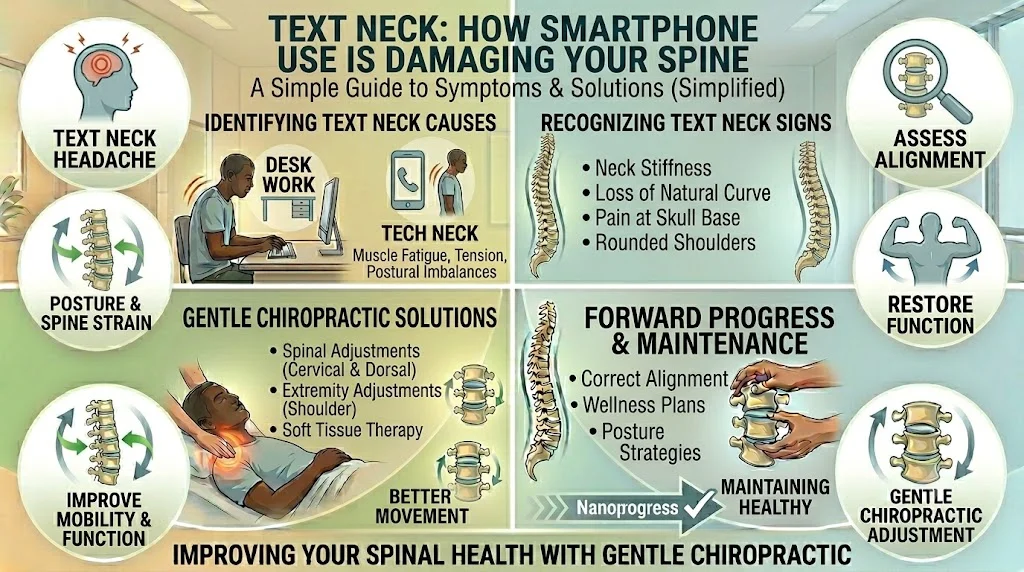
Look around Athens — at Sanford Stadium tailgates, downtown coffee shops, or the UGA campus between classes — and you’ll see the same posture everywhere: head down, shoulders rounded, eyes locked on a phone screen. It’s such a normal sight that most people never stop to think about what it’s doing to their spine.
But chiropractors have a name for it: text neck. And it’s becoming one of the most common — and most preventable — sources of neck pain, headaches, and upper back tension we see at our Athens clinic.
What Is “Text Neck,” Exactly?
Text neck refers to the repetitive strain injury caused by tilting your head forward and down for long periods to look at a phone, tablet, or laptop. It’s not an official medical diagnosis, but it describes a very real and measurable problem: forward head posture caused by prolonged screen use.
Here’s why it matters. An adult head weighs about 10-12 pounds in a neutral position. But for every inch it tilts forward, the effective weight on your neck and upper spine increases dramatically. At a 45-degree tilt — the angle most people use while texting or scrolling — your neck can be supporting the equivalent of 40+ pounds of pressure. That’s roughly the weight of an average 8-year-old child, resting on your cervical spine, for hours a day.
Why Athens Is a Text Neck Hot Spot
A few things make this an especially common issue locally:
- A huge student population. Between UGA students and staff, a large share of Athens spends hours a day on laptops and phones for classes, studying, and social media.
- Remote and hybrid work. More Athens professionals are working from laptops at coffee shops, kitchen tables, and couches — setups that rarely support good posture.
- Long commutes and downtime. Whether it’s scrolling on the bus, at a red light on Broad Street, or relaxing at home in the evening, phone use adds up fast.
None of this means giving up your phone. It means understanding what forward head posture does to your body — and catching it early.
Signs You May Already Have Text Neck
Text neck develops gradually, so many people don’t connect their symptoms to their screen habits. Common warning signs include:
- Chronic neck stiffness or a “crick” that won’t go away
- Tension headaches, especially at the base of the skull
- Rounded shoulders or a visible forward head posture
- Tingling or numbness radiating into the shoulders or arms
- Reduced range of motion when turning your head
- Upper back and shoulder blade pain
If any of these sound familiar, your neck may already be adapting — poorly — to hours spent looking down.
The Long-Term Risk: It’s Not Just Discomfort
The concern with text neck isn’t only the ache you feel today. Left unaddressed, chronic forward head posture can lead to:
- Accelerated disc wear in the cervical spine
- Loss of the neck’s natural curve, which is designed to absorb shock and support the head
- Nerve irritation, which can cause the numbness or tingling some people mistake for a pinched nerve
- Compensation patterns in the mid-back and shoulders as the body tries to offset the imbalance
The earlier this pattern is addressed, the easier it is to reverse. The longer it goes unchecked, the more the spine adapts to the wrong position — making correction slower and more involved.
How Chiropractic Care Helps Reverse Text Neck
At Well Adjusted Athens, we treat text neck as a functional and structural issue — not just a symptom to mask. Our approach typically includes:
1. Postural and spinal assessment We evaluate your cervical alignment, range of motion, and posture to understand exactly how your spine has adapted to screen habits.
2. Chiropractic adjustments Gentle, targeted adjustments help restore proper alignment in the neck and upper back, relieving nerve pressure and reducing pain at the source.
3. Soft tissue therapy Techniques like Graston Technique and cupping release the tight, overworked muscles in the neck, shoulders, and upper back that come from prolonged forward head posture.
4. Practical posture coaching Small changes — screen height, phone habits, workstation setup — make a big difference. We help patients build habits that support their treatment instead of working against it.
Simple Habits to Protect Your Neck Right Now
While professional care addresses existing damage, these habits can help prevent it from getting worse:
- Raise your phone to eye level instead of tilting your head down to it
- Take screen breaks every 30-60 minutes to reset your posture
- Set up your laptop with the top of the screen at eye level when possible
- Strengthen your upper back with simple exercises that counteract forward rounding
- Sleep with proper neck support to give your spine a chance to recover overnight
Don’t Wait for the Pain to Become Chronic
Text neck is easy to dismiss because it builds slowly — a little stiffness here, an occasional headache there. But by the time it becomes a daily ache, the spine has often been compensating for months or years.
If you’re an Athens resident who spends significant time on a phone or laptop — which, let’s be honest, is most of us — it’s worth having your posture and spinal alignment evaluated before small issues become bigger ones.
Ready to check in on your neck health? Schedule an appointment with Well Adjusted Athens today and let our team create a personalized plan to relieve your pain and protect your spine for the long run.
Ready to Get Started?
If you found this article helpful, take the next step today. Our team is here to help you with expert guidance and fast support.